


PROJECTS
PROJECTS 2022-23
Project Kalaa

Project Kaala is an initiative that aids in restoring the depleting flora while addressing the issue of growing paper waste. This project focuses on making common stationery items produced from recycled paper which contains plantable seeds that are environment-friendly, such as bookmarks, price tags, paper and pencils. The Seed Papers adorns forgotten Indian folk arts which symbolizes auspicious ceremonies and rituals of life, and empowers traditional artisans in the process. Through this project we strive to work with the communities that are well versed in folk arts who have been sighing off in recent years and promoting agriculture and creating employment.
Project Rangde


Project Rangde dyes fabrics using floral waste and turns them into cloth bags, pouches and scrunchies while eventually attempting to break through the textile industry with an unique and sustainable concept. Natural dyes that are derived from plant sources have become more popular in recent years to counter the negative repercussions and dangers posed by synthetic dyes as it is environment-friendly, hygienic, harmless, and more permanent than other colorants, especially synthetic dyes. With the aim of empowering and educating marginalized women, Project Rangde employs this method to make its products.
Project Dhaaga

At Project Dhaaga, we aim to raise awareness about the adverse effects of single-use plastic and polythene covers. The team strives to optimize plastic wastes by reusing plastic bags to make yarn and crochet them into durable accessories, organizers, coasters and planters. Project Dhaaga also strives to aid the community of underprivileged and needy women while producing goods that are both environmentally responsible and sustainable. The team's goal is to upskill the socially impoverished while also making a positive impact on a pollution-free environment and a reduction in plastic waste by repurposing it to make new and valuable products.
Project Nesara
Project Nesara produces bio-enzymes, which are liquid mixtures that contain natural enzymes and can be used to clean and treat various household surfaces. It is made by using fruit and vegetable waste in a definite proportion. This remedy is all-natural and free of harmful chemicals that pose a threat to both human health and the environment. The team strives to limit the hazardous gas emissions from landfills caused due to over accumulation of wet waste. The project supports society's transition to a chemical-free and sustainable environment. Project Nesara works with non-profit organizations and provides employment opportunities to the underprivileged.

Project Meira
Project Meira aims at developing a bamboo lantern which is a solution developed to tackle the power crisis. In India, a large majority of rural villages have no access to electricity and Project Meira provides a solution to this very problem. This lamp produces light by utilizing one of the valuable assets on Earth, the sea. It is a more dependable alternative to solar or electrical lighting as it is made up of recyclable materials and can be charged without relying on any kind of external power source. The lamp converts salt water or urine into electricity. For those who live in off-grid communities, it could provide a reliable and sustainable source of energy.
Project Khaady


Project Khaady aims to provide consumers with an alternative to plastic cutlery. This is done by manufacturing edible and biodegradable cutlery which are safe for consumption and promotes sustainability. At Project Khaady, our main aim is to replace plastic cutlery with edible and environment-friendly cutlery and promote reduced usage of plastic. Edible cutleries are biodegradable and would decompose naturally if thrown away or can be consumed leaving behind no waste. The project strives to work on this business model with the assistance of the underserved communities with an aim to provide them with an alternative source of income.
Project Viva


Project Viva strives to produce products filled with handcrafted and organic self care products that are cruelty-free and ethically sourced. The kit is a powerful blend of organic ingredients without parabens, sulfates, or other harmful chemicals. There is a wide variety of skin care products and other toiletries such as body scrubs, bath salt, shampoos, etc. that caters to the needs of all. Project Viva aims to collaborate with NGOs and communities and together put forward organic alternatives to existing personal care products.
PROJECTS
2020 and before
up- cycle it !
WHAT IS UP-CYCLING?
Up-cycling, also known as creative reuse, is the process of transforming by-products, waste materials, useless or unwanted products into new materials or products perceived to be of greater quality such as artistic value or environmental value.
AIM of the PROJECT.
Our main objective of this project is to use the power of up-cycling to tackle WASTE MANAGEMENT and also create a viable additional source of income for under-served communities thus enable POVERTY ALEVIATION locally.


#togetherwecare
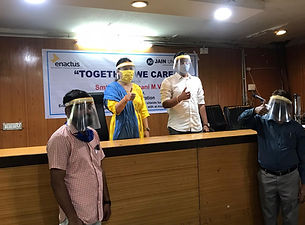
Even during the pandemic, we at Enactus JU wanted to continue to help our community. We saw the effect that COVID 19 had on the world and immediately then started thinking about ways to help our society rebuild itself.
It was right then that IIT Delhi wanted to collaborate with us on a nationwide project to help the frontline workers feel protected by providing them with face shields for free. We were glad to collaborate with them on this project to help our community strive.
And so we did...
The first stage of the project was a crowdfunding campaign, through which we were able to raise ₹3,60,000.
After concluding our crowdfunding campaign we jumped straight into the second step of delivering our shields. We managed to procure around 14,200 shields!! And after a thorough evaluation, we delivered these shields all across Karnataka.
Everyone from Policemen, Doctors and street cleaners were provided our shields help them execute a safer life.
We thank all our donors, volunteers, commissioners, transportation agencies, and every member of our team for helping us conclude this project successfully.


Khaagaz 2019-2020
Background
Project Khagaaz is an initiative towards making the world plastic-free substituting plastic with Paper Mache products. In this process we strived to empower underprivileged communities and providing them a source of income.
What We Do
With Project Khagaaz we came up with Paper Mache planters substituting plastic planters and Cement. The Planters were made of paper pulp mixed with adhesive and water. The Khagaaz project is a way of giving back to our roots. This initiative aims at creating biodegradable and inexpensive planters that are eco-friendly and at the same time providing employment to the targeted communities.

waste management 2018-2019
Background
The Waste Management Project was taken up as an initiative to bring in awareness and effective waste segregation in Jain (Deemed to be University), Bengaluru, to function in a better manner. Unlike hundreds of years ago, most of the waste increasingly belongs in the biodegradable category. This means simple waste management techniques such as burying and burning aren’t as effective any more
What We Do
The Enactus forum of JAIN (Deemed-To-be-University) came up with a strategy to segregate waste in in an effective manner. The team has made efforts to implement sustainable waste management practices on campus through multiple initiatives. Those initiatives include the placement of recycling bins outside classrooms, offices, and main spaces so the opportunity to recycle is easily accessible. The three-way segregation of waste is followed, and it is primarily instituted with some form of color coding. It works just like the way traffic lights are coded in people’s minds, allowing effective and efficient waste management.

udaan 2017-2018
What we do
In order to effectively deliver upon the mandate to end discrimination in the workplace in all its forms, we took the initiative to provide employment opportunities to the transgender communities. Seeking opportunity from the plastic ban movement due to hazardous impact of plastic usage in Bengaluru at that time, we found a common thread to tackling these issues, by replacing plastic bags with an ecofriendly alternative like the cloth bags, simultaneously providing employment opportunities to the target group.
Making beautiful and striking cloth bags by collecting unused cloth pieces from tailors is what project udaan aims at by providing them with independent income for the business that is directed towards them without any commissions in between.
By this we took a small step forward to contribute to the global sustainable development by creating an eco-friendly environment for all.

akshara 2016-2017
Background
Education must be an equal opportunity for all. Project Akshara was initiated with an aim to set up a library in the government school in Panditanahalli near Tumkur District. The children face a host of challenges, including a lack of necessary resources. This project was aimed at enhancing the learning outcomes and maximizing the use of resources for the children in the government school.
What we do
Project Akshara was originally an initiative with a vision of providing an educational infrastructure in the government school so that children can get access to a wide range of resources and gain extensive knowledge.


made by me 2016-2017
Background
Project Made by Me was a venture to give back to our roots. The overall project was an aim to provide empowerment and development of the underprivileged women in Paditanahalli by teaching them the art of making cloth bags. As women are concentrated in household chores their skills and capabilities are unrecognized and undervalued. As we know, women are suppressed by male domination and authority as the home supplier and chief. The presence of prejudices and concrete gender inequalities stimulates discrimination practices.
What we do
Made by me Project focuses on the overall upliftment of the underprivileged women who are dependent and subdued by the male head of the family. The women have trained the art of making cloth bags.
This was a step towards creating awareness and promoting the use of cloth bags simultaneously providing a sense of empowerment and responsibility to the women by giving them a source of income so that they become self-reliant.


sarakki lake restoration 2015-2016
Background
Project Sarakki Lake Restoration was taken up with the vision to rejuvenate Sarakki Lake. Over the past 10-15 years, it has come under severe stress in the wake of unplanned urbanization and has been reduced to a cesspool of sewage, dumps of debris, land encroachments, water hyacinth, and extinction of all forms of aqua and avian life. It was shrunk to almost half its original size of 82 acres and what remains is a cesspool of raw toxic sewage and mounds of construction debris. The citizens filed a petition in the high court, asking it to do something to rescue Sarakki. The High Court directed the authorities then to begin work on restoring the lake and bringing it back to its former glory.
What we do
The Sarakki Lake Restoration Project was an initiative to devise a restoration process of the Sarakki Lake with the joint efforts of the government schools taking a step towards realizing the dream of rejuvenation of the lake.
